

[ad_1]
Ron “Cherry Top” Ronson, CEO of HunkaChunk Chocolate Company, wants to hire your consulting firm to work your magic, but you’re hesitating. Why? Because you’re already busy.
Beyond busy. As a firm you’re running flat out and working overtime.
On one hand, you fiercely want the HunkaChunk project. Heck, you’ve been courting ol’ Cherry for years. In terms of capacity, though, the timing just couldn’t be worse.

If only there was another resource you could turn to. There is.
Your clients.
Consulting firms treat projects like Fred Flintstone’s car, with consultants’ legs pushing the heavy load while clients relax for the ride.
That’s hard work. Too hard. Tell Cherry Top and your other clients to put their feet down and push!
You can increase your consulting firm’s capacity, reduce over-utilization and maintain (or increase) your fees by enrolling your clients in the hard work of delivering a successful project outcome. Yabba dabba doo!
Of course, you can’t unceremoniously offload work to your clients. That would be tough to pull off, threaten your relationships and raise questions about your fees.
Instead, enroll your clients in your consulting engagements, revealing the wisdom, benefit and value of their active participation.
You’re not shirking the work, you’re graciously inviting them to gain more from their projects by performing vital tasks.
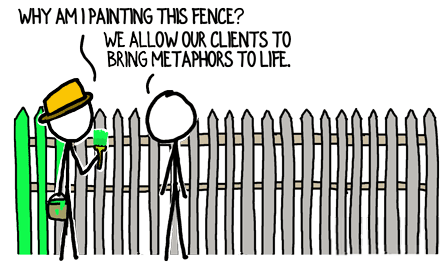
You’re Tom Sawyer offering your clients the opportunity to pay you for privilege of painting their own fence.
You can transfer work to your clients at numerous points during your consulting engagements.
Below are a few examples of how to utilize your clients as a capacity builder for your firm:
Work Sessions
In work sessions your team and your client’s team roll up your collective sleeves to tackle large chunks of your consulting project. Work sessions are the perfect mechanism for sharing the load.
Plus, you’ll develop superior outputs and raise the odds your client will adopt your solution.
Research and Analysis
If your project involves any scripted research, enlist an administrative person from your client’s staff to lead some (or all) of the calls.
Similarly, data cleaning and basic analysis can be tackled by your client’s junior analysts as long as you provide a template. (You’ll want to keep your proprietary analyses close to the vest, of course.)
Drafting Deliverables
There’s nothing wrong with saying to your client, “You take a first stab at this, then I’ll build on it” for parts of your consulting project. Particularly if you give directions, guidance, a framework and/or a template.
Think of it as skill transference. You’re training the client to do it themselves next time utilizing your consulting firm’s outstanding IP.
Similarly, many clients want your final consulting deliverable or presentation to be formatted with their company’s template.
Who better to wrestle your draft presentation into final form than someone on your client’s staff?
Presentations
Give your consulting client a role in any presentation you’re delivering to an audience that extends beyond the client’s core project team.
As with work sessions, sharing the spotlight can lighten your load while improving client buy-in and satisfaction.
QA and Testing
If your consulting firm’s solutions involve any type of technology or implementation, chances are a fair amount of QA and testing are involved.
Even non-tech solutions often need to be stress-tested to ensure your assumptions and execution are sound.
Testing is laborious, grinding, capacity-hogging work, and your clients can absolutely join in the fun.
Since they’ll be living with the ultimate output, it makes sense for them to participate in testing that output while the project is still active.
Do you ask your clients to pull some of the weight on their projects? If so, how?

Text and images are © 2025 David A. Fields, all rights reserved.
[ad_2]
Source link

